Email marketing strategies, automation tools, and lead nurturing campaigns are becoming essential for communicating effectively with an audience. Sending emails manually one by one is no longer efficient or scalable. Email marketing automation solves this problem by allowing the delivery of the right message to the right person at the right time through automated workflows. It helps improve efficiency, save time, and increase conversions while maintaining personalized communication, making it a key component of modern digital marketing services.
Understanding how email marketing automation works is important for both small businesses and large brands. With the right approach, it enables stronger customer relationships, consistent engagement, and sustainable growth.
What is email marketing automation?
Email marketing automation is the process of sending emails automatically based on user behavior, triggers, or predefined schedules. Instead of manually sending emails, you create workflows that run in the background.
For example:
- Sending a welcome email after someone signs up
- Sending follow-up emails after a purchase
- Sending reminders for abandoned carts
This approach ensures timely communication without constant manual effort.
Why is email marketing automation important?
Automation helps businesses scale their communication while maintaining personalization. It improves both efficiency and results.
Key benefits include:
- Saves time and effort
- Improves customer engagement
- Increases conversion rates
- Delivers personalized experiences
- Builds long-term customer relationships
With proper automation, you can turn leads into loyal customers more effectively.
How does email marketing automation work?
Email automation works based on triggers, conditions, and actions. These are set up inside email marketing platforms or automation tools.
Basic workflow structure:
- Trigger: User action (signup, purchase, click)
- Condition: Specific rule (location, behavior)
- Action: Email sent automatically
For example, when a user signs up (trigger), they receive a welcome email (action).
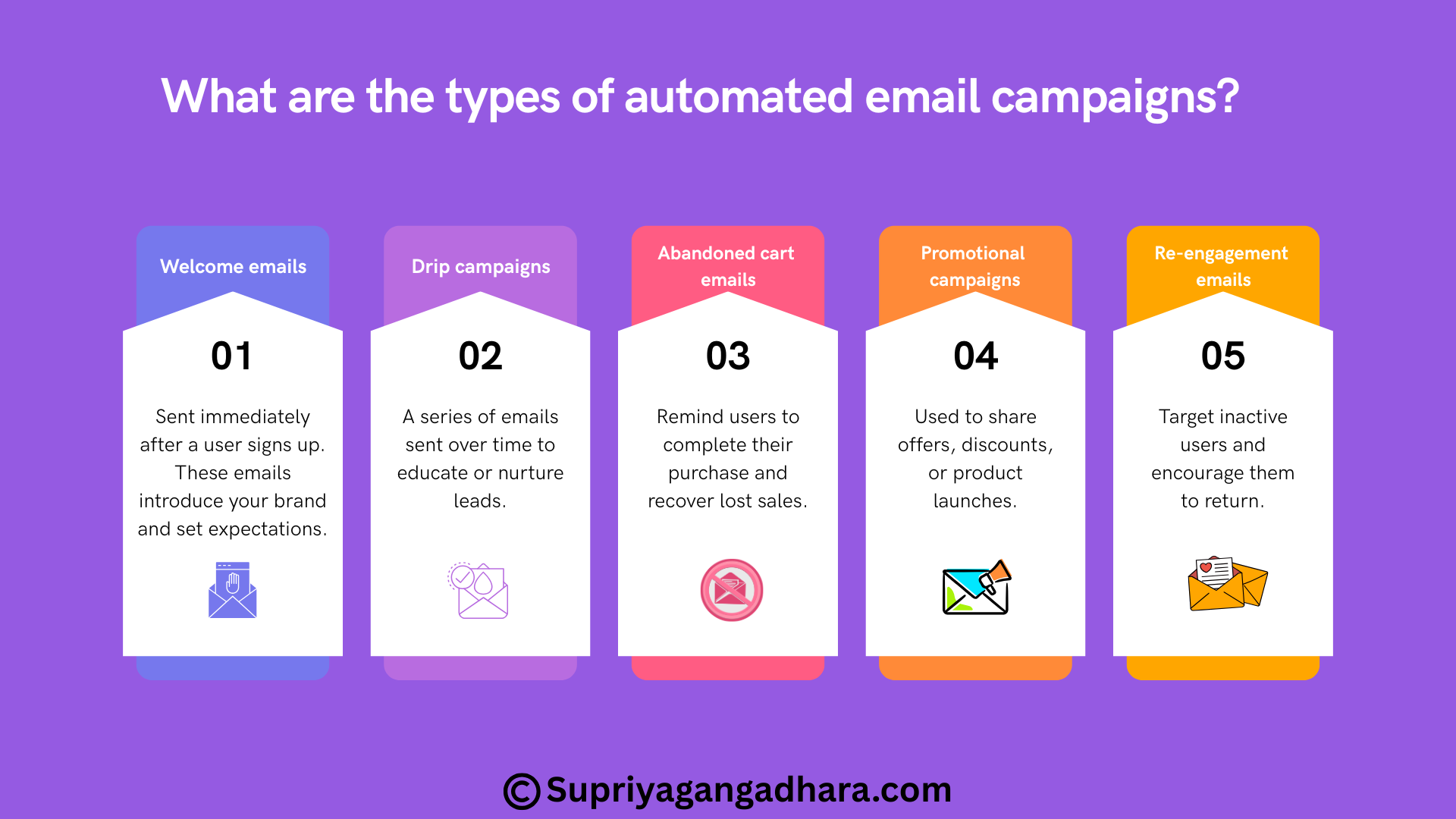
What are the types of automated email campaigns?
1. Welcome emails
Sent immediately after a user signs up. These emails introduce your brand and set expectations.
2. Drip campaigns
A series of emails sent over time to educate or nurture leads.
3. Abandoned cart emails
Remind users to complete their purchase and recover lost sales.
4. Promotional campaigns
Used to share offers, discounts, or product launches.
5. Re-engagement emails
Target inactive users and encourage them to return.
Using a mix of these campaigns improves overall performance.
How to set up email marketing automation?
1. Choose the right tool
Select reliable email automation software like Mailchimp, HubSpot, or ActiveCampaign. These tools offer templates and automation workflows.
2. Build your email list
Focus on growing a quality list using:
- Signup forms
- Lead magnets (ebooks, guides)
- Website popups
Avoid buying email lists as it can harm your reputation.
3. Segment your audience
Divide your audience based on:
- Demographics
- Behavior
- Purchase history
- Interests
4. Create engaging content
Your emails should be clear, valuable, and relevant. Focus on solving problems rather than just selling.
5. Set triggers and workflows
Define when and why emails should be sent. For example:
- Signup → Welcome email
- Purchase → Thank you email
- Inactivity → Re-engagement email
6. Test and optimize
Always test subject lines, email design, and timing. Small changes can improve results significantly.
What are the best practices for email marketing automation?
- Keep emails simple and clear
- Personalize your emails
- Optimize subject lines
- Focus on mobile optimization
- Maintain proper timing
- Monitor performance
Track metrics like open rate, click-through rate, conversion rate, and unsubscribe rate to improve campaigns.
What are the common mistakes to avoid in email marketing automation?
- Sending too many emails
- Ignoring audience segmentation
- Using generic content
- Not testing campaigns
- Poor email design
How can automation improve ROI?
Email marketing automation delivers one of the highest returns in digital marketing. By targeting the right users with personalized content, you increase engagement and conversions.
- A welcome email builds trust instantly
- A cart reminder recovers lost sales
- A follow-up email increases repeat purchases
Conclusion
Understanding email marketing automation is essential for modern businesses that want to grow efficiently. It helps you communicate with your audience at the right time, build stronger relationships, and improve overall marketing performance.
By using the right tools, creating valuable content, and following best practices, you can turn simple email campaigns into powerful growth engines. Start small, test your strategies, and continuously optimize for better results. Over time, automation will help you save time, increase engagement, and achieve higher returns on your marketing efforts.