Businesses use Google Ads to drive traffic, generate leads, and increase sales, but running ads alone does not guarantee results. Without proper optimization, campaigns can quickly become expensive and ineffective. For businesses looking to improve their overall online growth, investing in professional digital marketing services can also help create a more structured and result-driven strategy.
To get better performance, it is important to focus on the right strategy, including targeting the right audience, improving ad quality, and continuously refining your campaigns. Even small changes can have a significant impact on conversions and overall return on investment.
This guide covers practical tips to help you optimize your Google Ads campaigns and achieve better results from your advertising efforts.
Why is Google Ads optimization important?
Running ads without optimization can quickly waste your budget. Google Ads is highly competitive, and small improvements can make a big difference in performance.
Optimizing your campaigns helps you:
- Lower cost per click (CPC)
- Improve click-through rate (CTR)
- Increase conversion rate
- Maximize return on ad spend (ROAS)
- Reach the right audience at the right time
Now let’s explore the best tips to improve your campaign performance.
1. Set clear campaign goals
Before creating ads, define what you want to achieve. It could be website traffic, lead generation, or sales. Clear goals help you choose the right campaign type and measure success effectively.
2. Perform in-depth keyword research
Use keyword research tools, high-intent keywords, and long-tail keywords to target users who are ready to take action. Avoid broad keywords that bring irrelevant traffic.
Focus on search intent rather than just search volume.
3. Use the right match types
Google Ads offers different keyword match types:
- Broad match
- Phrase match
- Exact match
Using a mix of these helps control who sees your ads while improving targeting accuracy.
4. Write compelling ad copy
Your ad copy should be clear, engaging, and focused on benefits. Use ad copywriting techniques, include strong calls-to-action (CTA), and highlight what makes your offer unique.
Example CTAs:
- Get Started Today
- Book Your Free Demo
- Limited Time Offer
5. Optimize your landing pages
Even the best ads fail if the landing page is poor. Ensure your page is:
- Fast loading
- Mobile-friendly
- Relevant to the ad
- Easy to navigate
Good landing page optimization improves conversions and reduces bounce rates.
6. Use negative keywords
Negative keywords prevent your ads from showing for irrelevant searches. This saves money and improves targeting.
For example, if you sell premium products, you can exclude words like “cheap” or “free.”
7. Improve Quality Score
Google assigns a Quality Score based on:
- Ad relevance
- Expected CTR
- Landing page experience
A higher score reduces your cost per click and improves ad position.
8. Test multiple ad variations
Run A/B tests with different headlines, descriptions, and CTAs. This helps you understand what works best.
Testing regularly is one of the most effective conversion rate optimization techniques.
9. Focus on audience targeting
Use audience targeting, remarketing campaigns, and custom audiences to reach users who are more likely to convert.
You can target based on:
- Interests
- Demographics
- Online behavior
10. Use ad extensions effectively
Ad extensions improve visibility and provide extra information. Common types include:
- Sitelink extensions
- Call extensions
- Location extensions
- Callout extensions
They increase CTR and make your ads more useful.
11. Optimize for mobile users
A large percentage of users search on mobile devices. Ensure your ads and landing pages are mobile-friendly.
Use mobile-specific CTAs like “Call Now” or “Get Directions.”
12. Monitor and adjust bids regularly
Bidding plays a major role in ad performance. Use smart bidding strategies or manual adjustments based on performance data.
Increase bids for high-performing keywords and reduce bids for low-performing ones.
13. Use geo-targeting
Geo-targeting helps you show ads in specific locations. This is useful for local businesses or region-specific campaigns.
You can focus your budget on areas that generate the most conversions.
14. Track conversions accurately
Use tools like Google Analytics and conversion tracking to measure results. Track actions such as:
- Form submissions
- Purchases
- Calls
- Sign-ups
Without tracking, you cannot optimize effectively.
15. Analyze performance and keep improving
Regular analysis is key to long-term success. Review your campaign data weekly or monthly.
Focus on metrics like:
- CTR (Click-Through Rate)
- CPC (Cost Per Click)
- Conversion Rate
- ROAS (Return on Ad Spend)
Continuous improvement ensures better results over time.
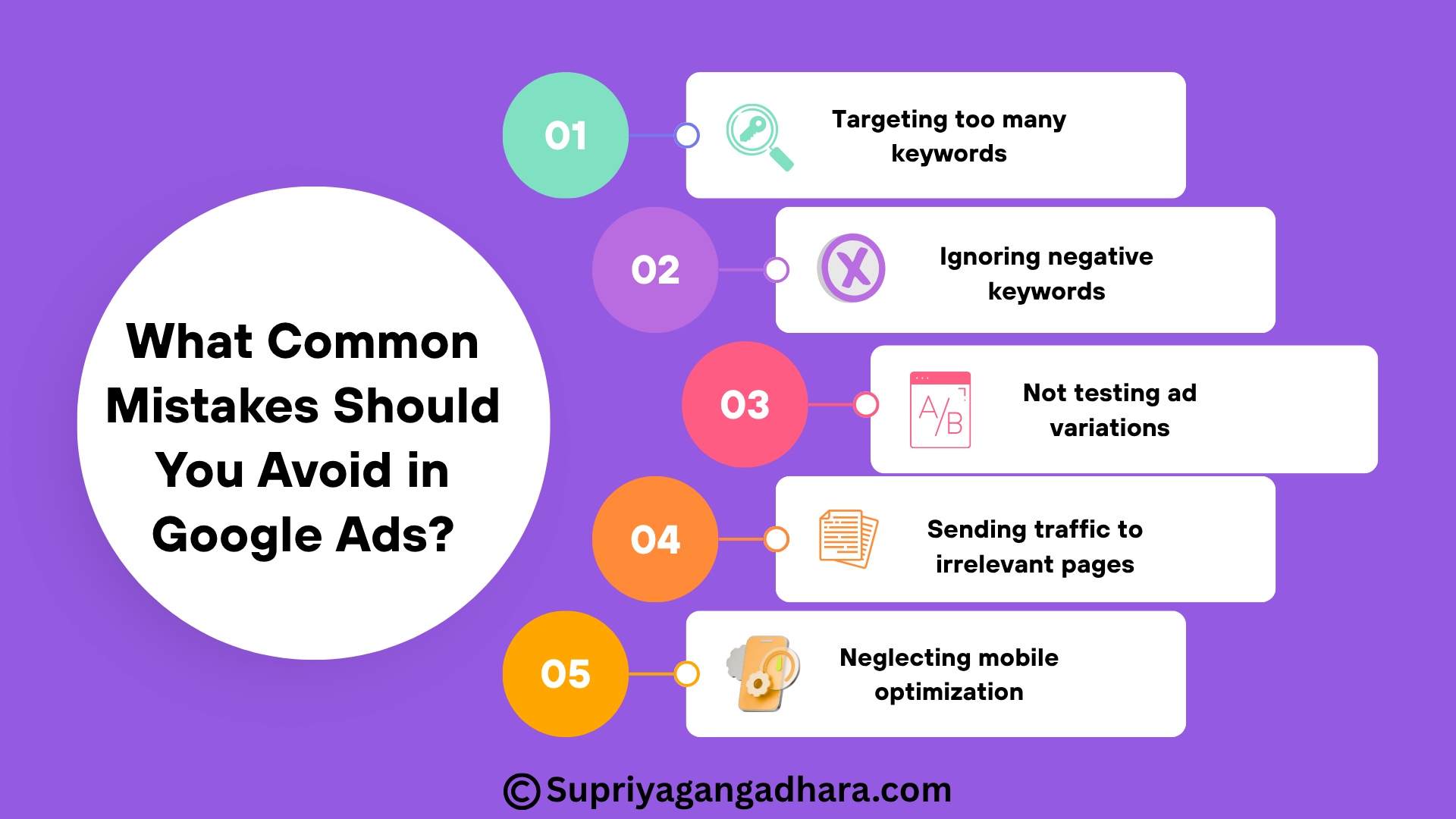
What Common Mistakes Should You Avoid in Google Ads?
Even experienced marketers make mistakes. Avoid these common issues:
- Targeting too many keywords
- Ignoring negative keywords
- Not testing ad variations
- Sending traffic to irrelevant pages
- Neglecting mobile optimization
Fixing these can quickly improve your campaign performance.
Conclusion
Effective Google Ads optimization is not a one-time task but an ongoing process that requires regular monitoring, testing, and improvement. By applying the right strategies, such as refining keywords, improving ad copy, optimizing landing pages, and targeting the right audience, you can significantly enhance your campaign performance.
Avoiding common mistakes and focusing on data-driven decisions will help you reduce wasted spend and increase conversions. Over time, consistent optimization efforts will lead to better results, higher efficiency, and a stronger return on investment from your Google Ads campaigns.